
Your recruiting journey starts long before a college coach contacts you.
Whether your goal is college cheer or STUNT, understanding the process early can help you prepare academically, develop the right skills, connect with coaches, and ultimately find the program and school that are the best fit for you. 

Use the USA Cheer Recruiting Center to explore college programs, understand the college recruiting process, build your recruiting profile, communicate with coaches, and navigate each step of your recruiting journey. 

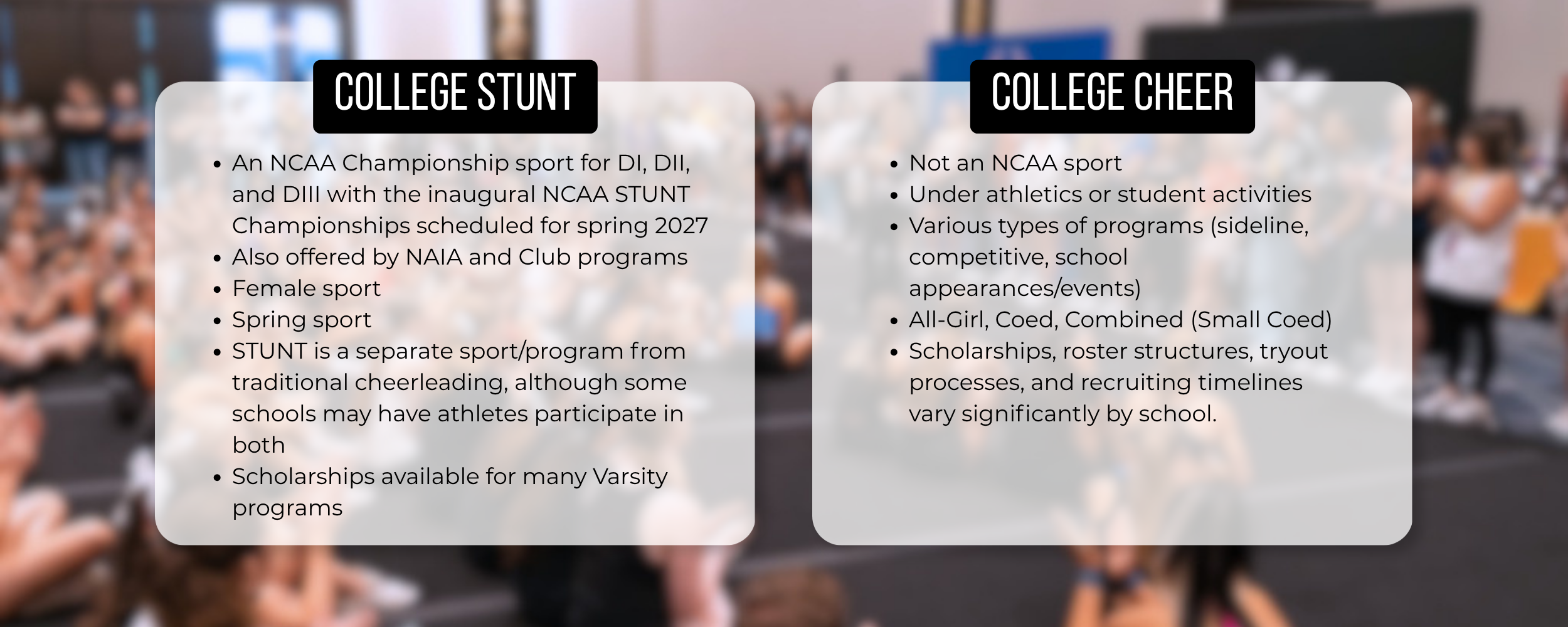
Understanding College Cheer and STUNT 
Finding Your Right Fit

The goal of recruiting isn’t simply to receive an offer—it’s to find a school and program where you can succeed academically, athletically, financially, and personally. It’s important to make sure the school as a whole aligns with what you’re looking for in your college experience—not just the Cheer/STUNT program.  

When researching schools, consider:  

Athletic Fit 

Athletic Fit 

  • Does the program match your current skill level? 
  • What skills are coaches recruiting for your graduation year?  
  • What position(s) does the program need?  
  • What is the roster size?  
  • How competitive is it to earn a starting or travel position?  
  • Does the school offer the type of program you’re looking for: cheer, STUNT, or both?   

Academic Fit 

Academic Fit 

  • Does the school offer your intended major?   
  • What are the admission requirements?   
  • What academic support is available to athletes?   
  • Can the athletic schedule work with your intended major? 

Financial Fit 

Financial Fit 

  • What is the total cost of attendance?   
  • Are athletic scholarships available?   
  • Are academic or merit scholarships available?   
  • Can they “stack” athletic scholarships with institutional scholarships? 
  • What additional team expenses should athletes expect?   

Personal Fit 

Personal Fit 

  • Campus size and location   
  • Distance from home   
  • Team culture   
  • Coaching style   
  • Housing   
  • Campus life   
  • Overall comfort with the school  

(Click to open, then “Save As…” or “Create a copy…” to save to your computer and allow editing.)

College Recruiting Timeline by Grade

Build the Foundation 

Focus Areas  

  • Develop strong fundamentals.  
  • Improve tumbling, stunting, jumps, and conditioning.  
  • Build good grades from day one.  
  • Attend camps and clinics.  
  • Explore different college programs.  

Action Items 

  • Create an NCAA Eligibility Center Account if you are considering NCAA STUNT. Make sure you select the account type appropriate for your division and recruiting status.  
  • Review your high schools list of NCAA-approved core classes and work with your school counselor to make sure you are taking the appropriate classes.  
  • Create a highlight folder of videos.  
  • Learn about divisions (D1, D2, D3, NAIA, JUCO).  
  • Follow college teams on social media.  
  • Attend college clinics/camps if allowed.  

Goal 

Become a stronger athlete while learning what types of schools interest you. 

Checklist 

  • Register with the NCAA Eligibility Center 
  • Build skills  
  • Focus on grades  
  • Attend camps  
  • Explore colleges 

Develop consistency and explore your fit 

Focus Areas 

  • Start becoming recruitable and gain exposure 
  • Continue working on skills and fundamentals 
  • Build your Recruiting Profile 
  • Research college programs more intentionally 

Action Items 

  • Continue checking your NCAA Eligibility Center Account for tasks and ask your counselor to upload your transcript at the end of the school year.  
  • Create Recruiting Profile – link to Recruiting Profile section 
  • Create your college interest list 
  • Dream Schools – Schools that may feel like a reach but are places you would love the opportunity to attend. 
  • Target Schools – Schools that are a strong match for your academic and athletic abilities and where you have a realistic chance of admission and competing. 
  • Safety Schools – Schools where you are confident you can gain admission and continue your athletic career, even if they may not be your first choice or at your preferred competitive level. 
  • Begin Emailing Coaches 

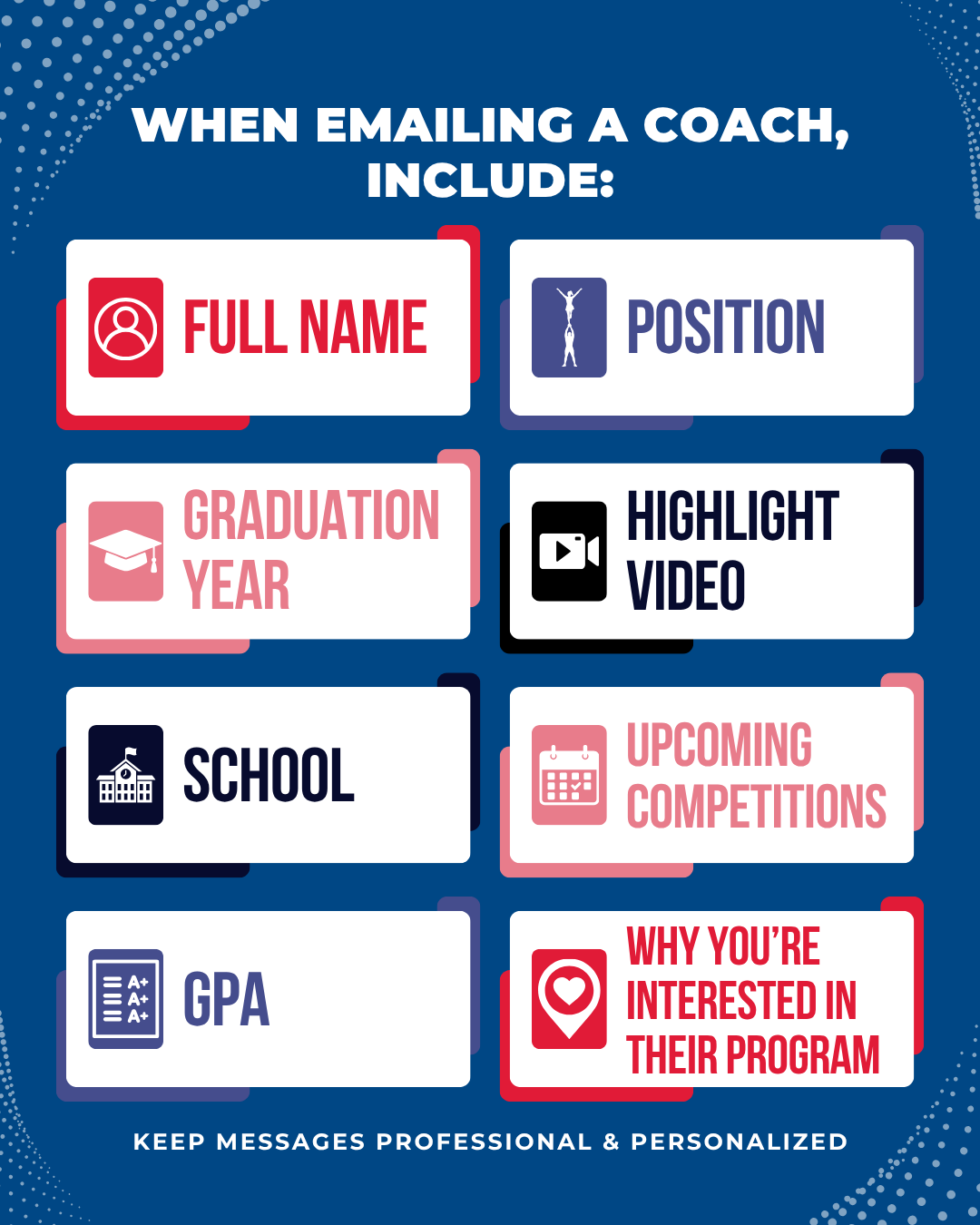
Introduce yourself and share your Recruiting Profile: 

  • Video  
  • GPA  
  • Graduation year  
  • Upcoming competitions  
  • Showcase schedule  

Goal 

Start getting on college coaches’ recruiting lists. 

Checklist 

  • Create recruiting profile 
  • Film recruiting video 
  • Email coaches 
  • Attend showcases 

Actively recruit and gain exposure
This is often the most important recruiting year. 

Focus Areas 

  • Improve skills  
  • Raise GPA  
  • Update videos every few months  
  • Narrow down college options 
  • Increase exposure and build relationships with college coaches 

Action Items 

  • Stay on track academically by working with your counselor to complete the NCAA-approved core classes to graduate on time 
  • Share your NCAA ID number with schools who are recruiting you 
  • Update your sports participation information and questionnaire before the start of your senior year.  
  • Make sure to ask your counselor to upload your current transcript before the start of the next academic year. 
  • College camps  
  • Recruiting combines  
  • STUNT showcases  
  • Prospect clinics  
  • Narrow Your List 
  • Dream schools  
  • Target schools  
  • Safety schools  

Schedule 

  • Campus visits  
  • Meetings with coaches (when permitted)  

Goal 

Build relationships with coaching staffs and start getting recruited 

Checklist 

  • Visit campuses  
  • Attend prospect camps 
  • Update videos 
  • Narrow school list 

Finalize your decision and prepare for college 

Finalize 

  • College Applications  
  • Complete FAFSA  
  • Apply for scholarships  
  • Continue recruiting conversations with coaches 
  • Make final decision  

Action Items 

  • Complete your final core classes 
  • Request final athletic certification in your NCAA eligibility account 
  • Make sure your counselor submits your final transcripts with proof of graduation once it becomes available.  
  • Continue updating coaches on your skills and sending new videos 
  • Continue visiting campuses  
  • Attend more camps/clinics if needed  

Goal 

Commit to the program that best fits your athletic, academic, and personal goals. 

Checklist: 

  • Apply to colleges 
  • Complete FAFSA 
  • Compare offers 
  • Commit to a program 

What College Coaches Look For

Athletic ability is only one part of recruiting. Coaches also evaluate:

Athletic Skills

Athletic Skills

  • Tumbling  
  • Stunting  
  • Jumps  
  • Motion technique  
  • Flexibility  
  • Strength  
  • Endurance  

Academics

Academics

  • GPA  
  • Course rigor  
  • Graduation status  

Character

Character

  • Leadership  
  • Coachability  
  • Work ethic  
  • Positive attitude  
  • Consistency  

Team Fit

Team Fit

  • Personality  
  • Communication  
  • Maturity  
  • Ability to work with teammates 

Build Your Recruiting Profile

Building a recruiting profile helps you clearly and concisely communicate the most important information about yourself to coaches. Your profile should include an introductory email, resume, and skills videos/social media accounts.
  • Name 
  • Grade level 
  • City and state you’re in 
  • School and/or gym 
  • Let the coach know you’re interested in their program and would like more information on their recruiting process/tryouts.  
  • Attach your resume and share either your video or give your cheer/STUNT social media account.  
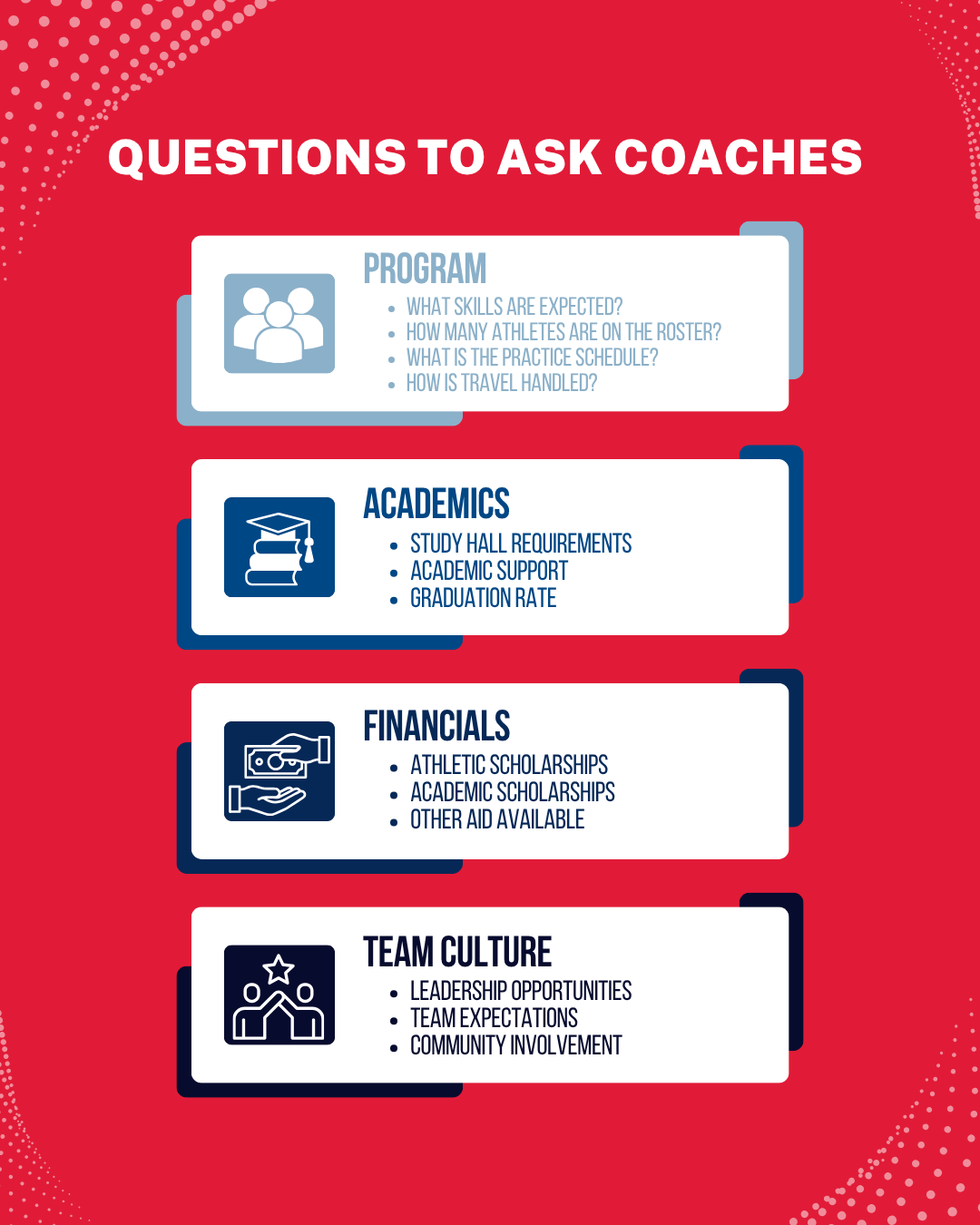
  • Ask what next steps are in their recruiting process 
  • Don’t be afraid to follow up if you don’t get a response in a week. 
  • Athlete photo  
  • Graduation year  
  • GPA  
  • School  
  • Gym  
  • Height  
  • Primary position  
  • Secondary positions  
  • Skills list  
  • Highlight video  
  • Coach contact information  
  • Competition schedule  
  • Academic interests  
  • Intended major (if known) 
  • Standing tumbling  
  • Running tumbling  
  • Jumps  
  • Stunting  
  • Basket tosses  
  • Specialty skills  
  • Game or competition footage  
  • Practice clips  

*Keep clips current and clearly labeled with your name and graduation year. 

Communicating with College Coaches

Parent Corner

Parents can support the recruiting process by:

  • Encouraging strong academics

  • Helping athletes stay organized

  • Visiting campuses together

  • Asking financial aid questions

  • Supporting the athlete’s independence in communicating with coaches