

College Cheer
School Cheer is a discipline of cheer that involves athletes in a scholastic setting who cheer in support of other sports, most often football and basketball. School cheerleaders’ primary role is supporting the other athletic programs through leading the crowd at games and pep rallies as well as promoting school spirit overall. School cheer teams may also participate in competitions, performing a 2-1/2 minute routine composed of tumbling, stunting, pyramids, dance, and cheer segments.
College program governance varies among their institutions, from being overseen by their activities office, sports department, to even their marketing department, depending on where they have the most support and resources. The NCAA, NAIA, and many of the community and junior college associations require the USA Cheer Safety & Risk Management training course for someone supervising a college cheer program.
Rules
The 2026-27 USA Cheer College Cheerleading Rules are available below.
SUMMARY OF CHANGES
As part of the rules process, 2026-27 is a “minor changes” year. Rules proposals for the 2027-28 school year can be submitted here.
- Added a definition for Prep Level.
- Added clarity to definition for spotter.
- C.3 – Added “middle layers” to list of positions from which a top can’t be released to an inverted position.
- C.5 – Requires a spotter of a released transition stunt to remain in position and spotting for two counts after the landing in order to make sure the stunt is stable.
- D.3.a – Clarified that a double cupie/awesome requires a spotter.
- D.8 – Added cradle to the list of skills from which a top person can be released to a hand-to-hand stunt.
- D.14.e.7 – Added wording to require three catchers for flips greater than one rotation only when they land in a stunt (which includes cradles and prone positions). The previous rule also required three catchers when landing on the performing surface. Performing surface landings have been removed from this rule and now only requires two catchers/spotters.
- E.2.g – Updated language to allow a pyramid spotter to move just prior to the dismount provided they remain focused on the top person and engaged with the pyramid. This allows an attentive spotter to move from front to back or vice versa even if they are not part of catching the cradle.
Download the 2026-27 College Rules
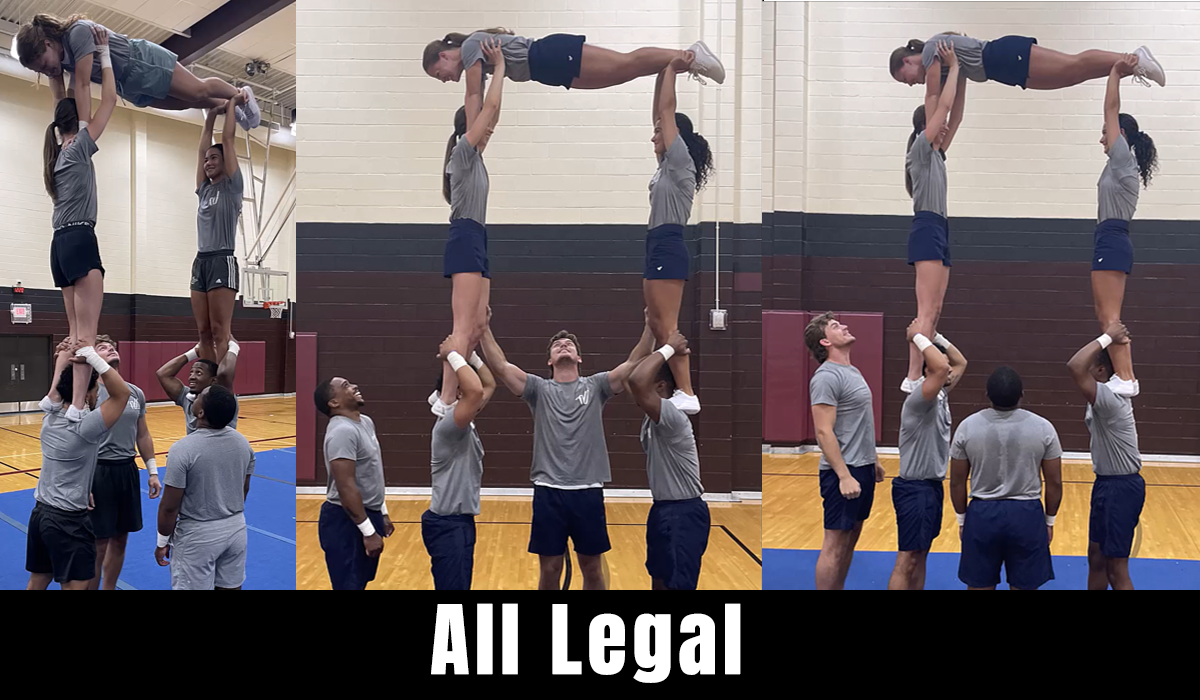
Examples of E.2.d spotting positions for a top person in a horizontal position:
The spotters can be in front and back, or one can be front or back while the other is at the head side of the top person.
Spotters cannot be at the foot side of the top person and be considered legally required spotters. In the images below, there is only one spotter in a legal position, which makes this skill illegal. The spotter at the foot side would need to move to be in front or back of the pyramid, opposite the other spotter, or move to the head side of the top person. To have a legal front/back spotter setup like above, neither spotter can be standing so far toward the feet that they are beside the base. Remember, the focus of the spotters should be to be in a position where they can protect the top person’s head, neck and shoulders.
