

Athletes: 6 Ways to Persuade Someone to Let you Take More Risks
USA Cheer has partnered with TrueSport, to provide new educational tools to equip coaches, parents and young athletes with the resources to build life skills and core values for success in sports and in life. TrueSport, a movement by the U.S. Anti-Doping Agency, inspires athletes, coaches, parents, and administrators to change the culture of youth sport through active engagement and thoughtful curriculum based on cornerstone lessons of sportsmanship, character-building, and clean and healthy performance, while also creating leaders across communities through sport.

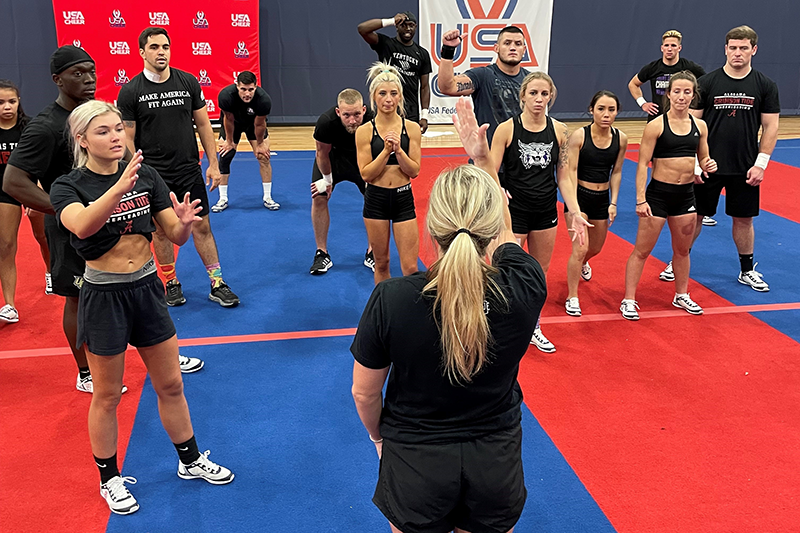

Taking risks is part of sport, and part of life: You won’t excel as an athlete if you don’t take shots that you know may not go into the goal, push harder in a run knowing you may not be able to hold the pace, or opt to try for a triple back handspring instead of sticking with the double. But taking risks can be scary—and sometimes, well-meaning coaches and caregivers want to hold you back, thinking that it’s for the best. But if you never push yourself, you won’t grow. And if you never fail, you won’t learn.
Here, board-certified family physician and TrueSport Expert Deborah Gilboa, MD, is sharing six ways to persuade coaches and caregivers to let you try the riskier choice—and live with the consequences.
- Look for opportunities to stress test your resilience or build resilience
To be clear, taking risks doesn’t mean engaging in risky behavior like underage drinking, unsafe driving, or blowing off classes. Rather, taking risks for young athletes may look like stepping up to new leadership positions or suggesting a bold new team strategy. Taking a risk simply means trying something new that, if it goes well, will mean growth and new opportunities for you. But with that potential, there is a chance that you will fail.
Simply put, taking risks means putting yourself in a position where failure is absolutely a possibility. “Risk taking is about giving yourself more opportunities to fail,” says Gilboa. “We talk a lot about wanting to build resilience, and the best way to do that is by having more opportunities to learn through failure.”
- Know what you really want
It’s not easy to persuade a parent or coach to let you try something new or make a key decision if you don’t actually know what it is you want, says Gilboa. You’re much more persuasive when you know your goal and why it’s worth trying for. As Gilboa says, it’s important to have a clear purpose for the risk, so be sure to ask yourself: What makes it worth it?
- Ask yourself what could go wrong
Rather than using a simple pros and cons list to assess a risk, Gilboa likes to start with a ‘what could go wrong’ list. “This needs to be a genuine question, not hyperbole or sarcasm,” she says. “I want an athlete to really think about what could go wrong if they take the risk. For example, if you want to be in charge of improving communication and responsiveness within your team during competition, how will you feel if your teammates get mad because the changes you make cause them to lose?”
It sounds scary or self-defeating to imagine what could go wrong, but it’s an important factor in risk-taking. If you aren’t ready to handle the potential downside of the risk, you may not be ready to take that risk.
- Make the case for your risk
Now, it’s time to present your case to the coach. If you’re asking for a leadership position, or you want the team to start taking more risks in your competitions rather than sticking with the same old strategy, you may need to demonstrate that your plan has merit before a coach will give you the green light.
Gilboa recommends developing a plan to share with your coach or caregiver that outlines the step-wise progression you want to take to get to your goal. “If you’re a diver, you don’t just go from the lowest platform to the highest one,” she says. “You have a long progression as you master skills and gradually step up. How can you slowly increase your risks? The goal should be to step up the risk, not leap up.”
In a team setting, Gilboa adds that taking the coach’s motivations into account can be helpful as well. “If you can explain how this particular solution or risk will get them closer to something they've said that they want, you’re more likely to get a yes,” she says. “You have to show the coach that letting you try this new thing puts them on a path towards a goal you know they have.”
- Ask follow-up questions
If your caregiver or coach comes back with an instant ‘no,’ Gilboa says that the answer isn’t to walk away frustrated. Instead, ask follow up questions for clarification and to create a path forward. For example, if the coach doesn’t want you to try the high dive, insisting that you’re not ready for the tallest platform, ask what steps you would need to take for them to consider you prepared.
“Rather than getting defensive, you’re better off being genuinely curious and saying, ‘Can you help me understand what your concerns are?’” Gilboa says. This can help you hone in on what you need to change in your plan in order to gain their trust and buy-in.
- Remember that failure is part of the process
With any risk comes the very real chance that you will fail—and that’s a good thing. When taking risks, the payoffs can be great, but you also need to accept the consequences gracefully when things go wrong. Gilboa also notes that if you’re consistently failing and not seeing any forward progress, you may need to dial back and take smaller steps towards your goal.
Takeaway
Athletes can greatly benefit from making more decisions and taking risks in their sporting lives, since learning to take calculated risks in sport translates to important life skills later. However, they may need to persuade parents and coaches to grant them more responsibilities and allow them to make riskier choices. And anytime an athlete decides to take a risk, they need to be able to live with the consequences.
What is TrueSport?

The TrueSport Champion Network is a community of coaches, parents, program directors, and athletes who believe in the power of youth sport to build life skills and core values for success both on and off the field. Join TrueSport Champion Network to help promote the positive values of cheer, dance, and STUNT!
The TrueSport Coaching Education Program empowers coaches—the most significant influencers in young athletes’ lives—with a transformative learning opportunity to obtain the knowledge and resources to cultivate, champion, and uphold the rich promise and highest potential of sport.
Additional Training Modules from TrueSport
USA Cheer is proud to partner with USADA’s TrueSport® to bring relevant educational content to the Cheer and STUNT community in order to promote a positive youth sport experience. We are excited to provide access to TrueSport’s experts that take coaching beyond skills and help truly develop the overall athlete by building life skills and core values for success on and off the mat, sideline, field, and court.
Feel free to share these resources with your coaching staff, parents, or athletes!
About TrueSport
TrueSport®, a movement powered by the experience and values of the U.S. Anti-Doping Agency, champions the positive values and life lessons learned through youth sport. TrueSport inspires athletes, coaches, parents, and administrators to change the culture of youth sport through active engagement and thoughtful curriculum based on cornerstone lessons of sportsmanship, character-building, and clean and healthy performance, while also creating leaders across communities through sport.
For more expert-driven articles and materials, visit TrueSport’s comprehensive library of resources.
This content was reproduced in partnership with TrueSport. Any content copied or reproduced without TrueSport and the U.S. Anti-Doping Agency’s express written permission would be in violation of our copyright, and subject to legal recourse. To learn more or request permission to reproduce content, click here.